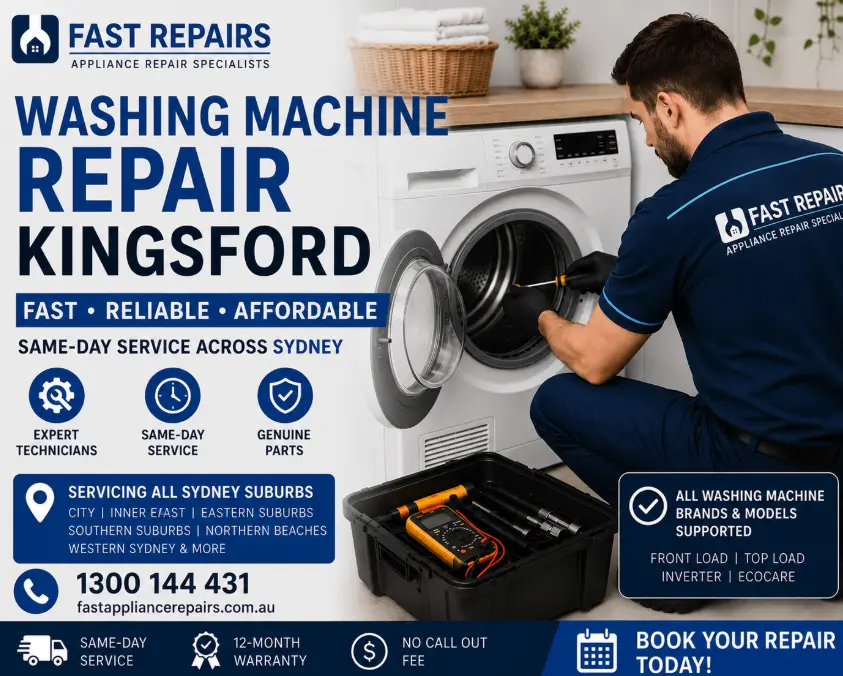
Fast Appliance Repairs provides washing machine repair in Kingsford and the surrounding Eastern Suburbs for front load, top load and automatic machines. A machine that will not start, will not drain, leaks, shakes across the laundry floor or stops partway through a cycle can usually be diagnosed by an experienced appliance technician, and in many cases repaired without replacing the appliance. Describe the symptoms over the phone, and we can talk through what is likely involved before anyone attends.
Parts & labour fully covered
A washing machine repair is really two jobs: working out what has actually failed, then fixing it. Rushing the first step is how people end up paying for a part that was never the problem.
Symptoms overlap heavily. A machine that won't spin and one that won't drain look identical to the owner. Diagnosis means testing components rather than assuming.
From drums, bearings, and pumps to motors, control boards, and pressure sensors. Plenty of faults sit across both, so we check the whole system.
Where a part has genuinely failed, replacement is straightforward. We supply and fit pumps, belts, door locks, inlet valves, heating elements and control boards.
Sometimes a repair is not worth doing. We assess the machine's age, condition, and parts cost, and will give you the honest answer before you spend.
These faults account for most washing machine calls across Kingsford. The causes listed are possibilities; only testing on the machine itself narrows it down.
If there's no power, check the supply and safety switch. If it powers up but won't run, candidates include the door lock, start switch, or a faulty control board.
Often load imbalance, a drainage problem, a broken drive belt, a failed pressure sensor, or worn drum bearings holding the spin cycle back.
Usually a blocked drain pump filter, kinked hose, a failed drain pump, or a sensor fault preventing the pump from running at all.
Leaks can come from inlet hoses, the door seal on a front loader, the detergent dispenser, or the pump. Overflow from excess detergent is also commonly mistaken for a leak.
Rumbling points to worn drum bearings. Scraping can be an object caught between the drum and tub. Squealing may indicate a belt or pulley issue.
Usually uneven load distribution, poor levelling, transit bolts left in (on new machines), or genuine wear like damaged shock absorbers and suspension springs.
Start with the taps, which need to be fully open, and both hot and cold if the machine uses both. Check the inlet hoses for kinks, and the inlet filter screens where they connect, as those catch sediment and restrict flow. If they are clear, the possibilities move to the water inlet valve, the pressure sensor telling the machine how much water is in the drum, the door lock circuit, or the control board. Very low household water pressure can also cause a machine to time out.
A machine that halts partway through is reporting something outside its expected parameters. Drainage problems stall a cycle, since the machine will not progress until it senses the water has gone. Fill problems do the same at the other end. Note the point in the cycle at which the machine stops and any code it displays.
Error codes tell the technician which circuit or function the machine believes has failed, not which component has actually failed. A drain-related code means the machine did not detect the water leaving within the expected time. Give us the code with the brand and model and we will interpret it.
We assist with repairs for a range of washing machine brands, subject to model, parts availability and fault diagnosis. Brand matters because European front loaders, direct-drive Korean machines and Australian/NZ top loaders are built differently.
Direct-drive Korean machines with advanced electronics, sensor technology and specific motor designs.
European-designed front loaders built for efficiency, often requiring specific factory components for accurate repairs.
Popular top and front load models featuring straightforward mechanics alongside complex control systems.
We also service Haier, Asko, Hisense and Whirlpool machines. We confirm parts availability before recommending a repair.
Most domestic washing machines are built for roughly eight to twelve years of regular use. A machine well inside that range is generally worth repairing. A repair costing a modest fraction of a comparable new machine is usually good value. However, if an older machine needs a major component (like a bearing replacement or control board) or parts are discontinued, replacement is often the better route. We give you the information to make the decision.
Cost depends on the fault, the parts required and the brand. Clearing a blocked filter or hose sits at the lower end. Pumps, door locks, inlet valves and belts sit in the middle. Control boards, motors and drum bearing work sit at the higher end. You are told what the repair involves before work starts.
In most cases, yes. Washing machines are plumbed and wired in place, so on-site repair is standard. A small number of jobs, usually major drum or bearing work, are impractical in a confined apartment laundry, and we will say so if that applies.
Redistribute the load and run a spin cycle on its own. If water remains in the drum, treat it as a drainage problem and check the filter and hose. If the drum is empty and it still will not spin, the likely areas are the door lock, drive belt, motor or pressure sensor, and it needs a technician.
Most often a blocked drain pump filter, a kinked or blocked drain hose, or a blocked household standpipe. A failed pump, an object caught between drum and tub, or a sensor fault are also possible.
It depends on the fault, the parts cost, their availability and the machine's condition. A single failed component on a sound ten-year-old machine is often worth fixing. Bearing failure or a control board at that age frequently is not.
Yes. We service front loaders (door seals, door locks, pumps, bearings, control boards) and top loaders (lid switches, belts, couplings, transmission faults).
It helps a great deal. The model and serial number are usually on a sticker inside the door frame, under the lid or on the rear. With them we can check parts availability and interpret error codes accurately.
Switch the machine off at the wall first, then reset the switchboard. If it trips again with the machine plugged in, leave it off and arrange an inspection. A repeated trip usually indicates a fault inside the appliance.
Kingsford sits in Sydney's Eastern Suburbs, and the housing mix shapes the work we see: a high proportion of apartments alongside semis and freestanding homes. Apartment laundries are often small internal spaces with shared drainage, while older walk-up blocks frequently have legacy plumbing. We navigate all of these environments.
Kingsford NSW 2032, Kensington, Randwick, Daceyville, Maroubra, and Coogee.
Eastlakes, Rosebery, Zetland, and Waterloo.
A washing machine fault rarely improves on its own. Tell us your brand, model number, and the symptoms, and we will get the diagnosis started straight away.
45 Monaro Street, Seven Hills, NSW 2147, Australia
Call 1300 144 431 or email [email protected] to discuss the problem and arrange service for your address in Kingsford or the surrounding suburbs.