Washing machine repair Vaucluse households can book with confidence begins with a proper on-site diagnosis rather than a guess made over the phone. If your washer will not drain, refuses to spin, leaks across the floor, will not start, takes an age to fill, or never seems to reach temperature, Fast Appliance Repairs covers Vaucluse and the surrounding Eastern Suburbs across front loaders, top loaders, integrated machines and washer dryer combinations from every major brand.
Washing machines rarely fail the way the symptom suggests. A machine that will not spin usually has a drainage fault, because most washers refuse to spin while water remains in the tub. And in a large house, two of the most common complaints, slow filling and washes that never feel warm, are frequently about what is reaching the machine rather than the machine itself. To book a washing machine technician for Vaucluse, call 1300 144 431 and describe exactly what the machine is doing.
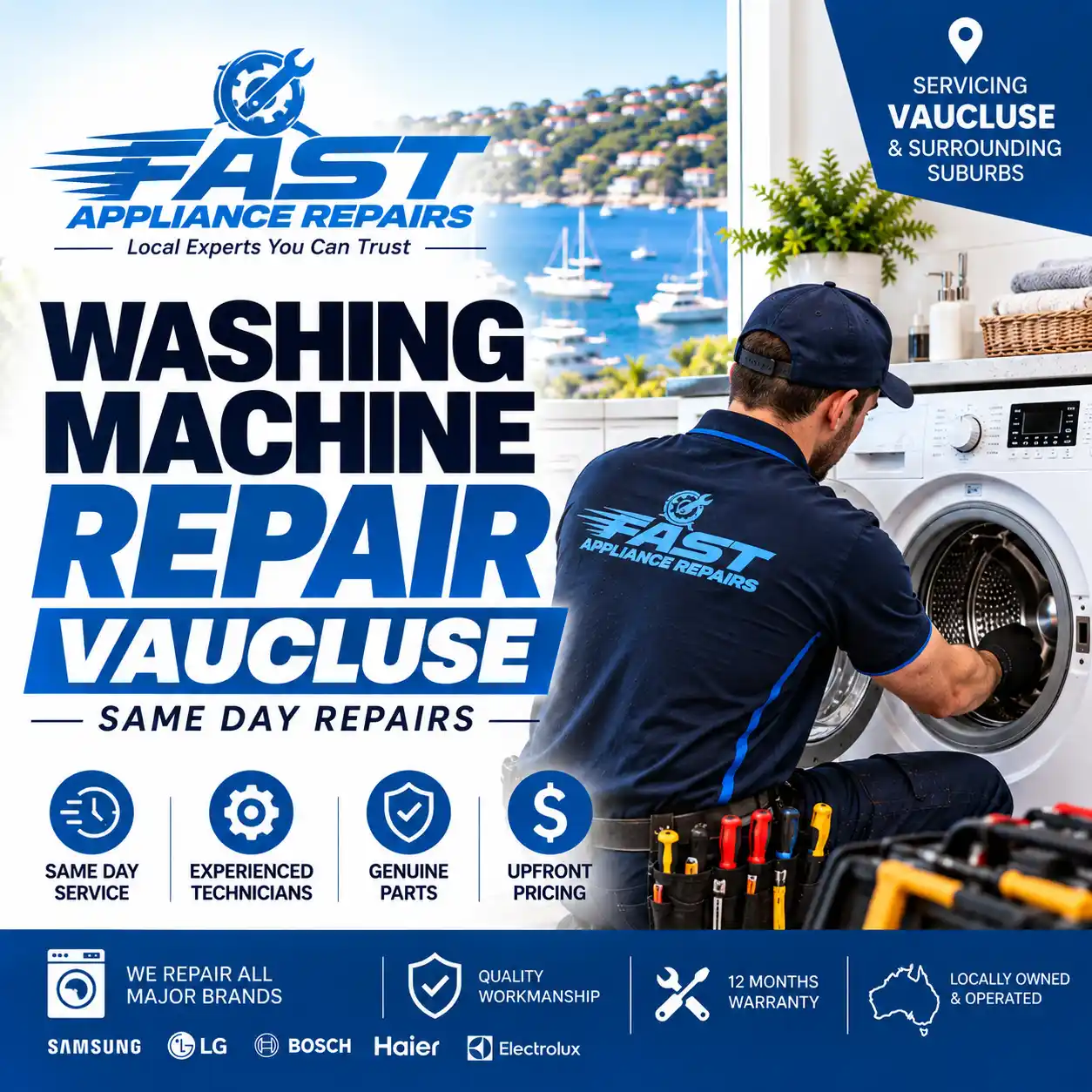
Multi-level harbourside residences, renovated integrated laundries, and family homes across Vaucluse serviced with precision on-site diagnostics, genuine parts, and transparent upfront quotes.
Front loaders, top loaders, integrated cabinetry units, and washer dryer combinations serviced with genuine replacement parts.
Methodical testing of long hot water pipe runs, upper-floor water pressure, and cold-fill internal heating systems in large homes.
Prompt replacement and care for front loader door seals and boot gaskets degraded by residual pool chlorine on towels and swimwear.
We test your washing machine under power and water before quoting parts and labour clearly. Complete diagnostic transparency first.
Need prompt technician attendance in Vaucluse or the Eastern Suburbs? Call our service line directly.
Call Dispatch: 1300 144 431Vaucluse has a high proportion of very large homes, often over several levels on a sloping block, and the laundry is frequently a long way from both the hot water unit and the water meter. That distance causes two complaints we attend regularly where nothing inside the appliance has failed.
The first is a wash that never feels warm. Where a machine is plumbed to both hot and cold, it draws whatever is sitting in the hot pipe at the moment the valve opens. In a large house that pipe may hold several metres of water that has gone cold since it was last used, and a washing machine uses so little water per fill that the cycle can be over before genuinely hot water ever arrives. The owner concludes the heater has failed or the machine is not heating. Neither is true, and the usual answer is either to run the nearest hot tap until it runs hot immediately before starting the cycle, or to select a programme that heats internally.
It is worth knowing that many modern machines are cold-fill only by design. They connect to the cold tap and heat the water themselves with an internal element, so the hot pipe is irrelevant. If yours is cold-fill and washes are running cold, that points at the element or the thermistor and is a genuine fault worth diagnosing.
The second is slow filling on an upper floor. Supply pressure drops with height, and a laundry on the top level of a multi-storey house, particularly on the high side of a sloping block, can see noticeably less pressure than a ground floor tap. A machine that fills slowly will run long cycles and can throw a fill error even though the valve is healthy. Comparing fill speed with a tap on the same level usually tells you quickly whether the appliance or the supply is at fault.
Neither of these means you should not call. They mean the diagnosis starts with the supply rather than the parts, which is how we approach it here. Call 1300 144 431 and mention where in the house the laundry sits.
The other thing that shortens machine life in this suburb is what comes off the pool. Chlorine is hard on rubber and elastic, and towels and swimwear carry residual chlorine into the machine on every load. Over time that degrades the door seal on a front loader, which hardens, cracks and eventually leaks, and it breaks down the elastic in swimwear long before the fabric wears out.
Rinsing swimwear and pool towels in fresh water before washing reduces it considerably, and wiping the door seal fold dry after a heavy pool-season load helps further. Door seals are inexpensive parts and a straightforward replacement, but they are the component that most often fails early in a household with a pool.
Methodical on-site diagnostics, authentic replacement parts, and dedicated workmanship across all washing machine faults.
Water sits in the drum at the end of the cycle, usually with an error code. The pump filter is the first suspect, and on most front loaders it sits behind a small access panel at the base where you can safely check it. Coins, hair clips, lint and underwires collect there. Beyond the filter, the causes are a kinked or blocked drain hose, a blocked sump hose, a failed drain pump, or a partly blocked waste line, which is more common in older homes and in long drain runs.
The cycle finishes and the load is still soaking. Drainage gets checked before anything else, because a machine that cannot empty will not spin. Where drainage is clear, the likely causes are a worn or snapped drive belt on belt-driven models, a failed door lock the control reads as unsafe, worn motor brushes on older brushed-motor machines, or a control board not commanding the spin. It is also worth confirming the programme selected, since wool and delicate cycles spin far more gently by design.
The cycle starts but no water enters, or filling is unusually slow. Begin with both taps fully open, then check the inlet hose filter screens, which trap grit and scale and are simple to clean. Beyond that, a failed inlet valve solenoid, a pressure sensor reporting a false full reading, or genuinely low supply pressure, which upper-floor laundries in large homes are prone to. Comparing the fill rate against a nearby tap is a quick way to separate the two.
Clothes come out clean but cold, or a warm wash never gets there. On a cold-fill machine the water is heated internally, so this points to a failed heating element, a faulty thermistor, or a control fault, and it often presents as a stalled cycle because the machine waits for a temperature it cannot reach. On a hot-and-cold connected machine in a large house, the long pipe run described above is frequently the whole explanation, so both are checked.
Locating the leak is the work; the repair is usually straightforward once found. Water at the front of a front loader most often comes from a perished or torn door seal, or an object caught in the seal fold. In a pool household seals perish earlier, so they are worth inspecting before they fail outright. Water at the rear generally means a split hose, a loosened clamp, or a failing inlet valve. Water underneath can be a cracked sump, a failed pump seal, or a dispenser overflowing from excess detergent. In an integrated installation a slow leak can run under joinery unnoticed for weeks.
Nothing happens when you press start. Confirm the door is fully latched, both taps are on, the outlet is live and the circuit breaker has not tripped, checking the correct sub-board if the laundry is on its own circuit, which is common in larger homes. If all four check out, the fault is internal: a failed door interlock, a faulty start switch, a control board fault, or a break on the supply side.
The character of the noise narrows it considerably. Deep rumbling or grinding that rises with spin speed points to worn drum bearings, the most serious of the common front loader faults. A scraping or metallic scratching during the wash usually means something caught between the inner and outer drum. Clunking during agitation is often a foreign object too. A high-pitched whine can indicate a failing drain pump, and squealing generally means a belt. If a noise appeared suddenly and is worsening, stop using the machine and call 1300 144 431, because a failing bearing left running damages the drum and outer tub as well.
A machine that shakes hard during spin is usually not electrically faulty. Transit bolts left fitted after delivery, unlevel or unlocked feet, a flexing timber floor, and overloading account for most cases. In a large house with a laundry above a living area, vibration carries further than people expect, and an integrated machine transmits it straight into the joinery. Where the machine has always sat steady and the shaking is new, worn shock absorbers, failed suspension legs or a loose counterweight are the likely causes.
A door that will not open at the end of a cycle almost always means water remains in the drum, because the interlock will not release while the machine believes the tub is full. Clearing the drain fault normally releases it. A door that will not lock at the start points to a failed interlock, a misaligned striker plate, or worn hinges letting the door sit low. On an integrated machine carrying a cabinetry panel, the extra weight brings hinge wear into it sooner. Forcing a locked door damages the lock body and the frame.
If the machine powers up and fills but the drum stays still, the drive system is where to look: a snapped belt, a failed motor, worn motor brushes, or on direct drive machines a failed rotor position sensor or drive board. On top loaders, a worn drive coupling or failed transmission produces the same result. A drum that turns freely by hand but not under power indicates a drive fault. A drum with noticeable movement when lifted suggests a worn or failing bearing.
The timer stalls and the cycle never advances. This normally means the machine is waiting for a condition it cannot reach: a fill level it never achieves, a temperature it cannot hit, or a drain it cannot complete. Slow filling and heating faults both present this way, which is why supply is checked alongside components. Repeated rebalancing attempts on an overloaded drum can also stretch a cycle until it appears stuck.
Note exactly what appears on the display, including flashing light patterns on models without one. Codes group into recognisable categories: drainage, fill, heating, door lock, motor and communication faults. The code reports the condition the machine detected, not the component that caused it, so it is a starting point rather than a diagnosis. A fill code, for instance, is as likely to mean low supply pressure as a failed valve. Where there is a burning smell, visible sparking, or a machine tripping the circuit breaker or safety switch, switch off at the wall and stop using it, then call 1300 144 431.
Front loaders dominate in Vaucluse, particularly in renovated homes where an integrated or under-bench installation is the practical choice. Their faults cluster around the door seal, door interlock, drain pump, drum bearings and suspension, and they need the pump filter cleaned periodically, which many owners are never told about.
Integrated and built-under machines are serviced the same way once accessible, but reaching them takes longer, and sometimes a cabinetry door panel or benchtop fixing has to be removed first. Mention at booking that a machine is integrated or built under so the right amount of time is allowed.
Top loaders remain in some Vaucluse homes, generally simpler and cheaper to work on, with faults concentrated on the lid switch, the agitator or impeller drive coupling, the transmission or clutch on older models, the water level pressure switch, the inlet valve and the drain pump.
Second laundries are common in larger homes here, and the secondary machine is usually the retrofit, plumbed wherever a connection could be reached. Those are the installations with the longest supply and drain runs and the most pressure and drainage quirks. Washer dryer combinations also appear where a second appliance will not fit. (Washer Dryer Combo Repair Sydney).
We service all major washing machine brands, including the European models common in this part of Sydney.
Miele and Asko, built for long service lives and worth diagnosing methodically rather than replacing parts speculatively. Bosch, well supported for parts and common in renovated Vaucluse laundries, including their integrated ranges. (Bosch Washing Machine Repair Sydney).
Samsung, across their front load range including EcoBubble and inverter direct drive models. LG, whose direct drive machines sidestep belt faults but bring their own sensor and board considerations. Fisher and Paykel, found in local homes of every vintage. Electrolux and Westinghouse, both widespread across the Eastern Suburbs.
Simpson, still working in plenty of established laundries. Whirlpool, Beko, Haier and Hisense, common in recent installs. (Haier Washing Machine Repair Sydney).
Most washing machine repair work concentrates on a predictable list: drain pumps and pump filters, water inlet valves and inlet hose screens, door locks and interlock assemblies, door seals and boot gaskets, door hinges, drive belts and pulleys, motors and motor brushes, drum bearings and shaft seals, shock absorbers and suspension legs, pressure switches and level sensors, heating elements and thermistors, detergent dispensers, sump hoses and drain hoses, lid switches and drive couplings on top loaders, and control and interface boards.
Door seals come up more often here than in most suburbs because of chlorine exposure, and heating elements and thermistors more often on cold-fill machines doing the heating work themselves. Bearings, motors and control boards are the costly ones, and each is properly tested before it is ever recommended. Availability and lead time on components for premium and integrated models vary by brand, which is why we confirm the model number at booking.
Every washing machine repair Vaucluse booking follows the same sequence.
Cost follows the part and the labour needed to reach it, not the badge on the front of the machine, though on premium models the badge does affect what a component costs and how quickly it arrives.
At the low end sit blockage clearing, pump filter cleans, foreign object retrieval, inlet screen cleaning, levelling and hose replacements, often not far above the attendance itself.
The middle band covers drain pumps, door locks, inlet valves, belts, door seals, hinges, heating elements, thermistors and pressure switches, and these account for the largest share of the work we carry out. At the upper end sit drum bearings, motors and control boards.
Bearings are expensive less because of the part and more because reaching them means dismantling most of the machine, and on sealed-tub designs the outer tub is replaced as a complete assembly. Integrated installations add access time before the repair itself begins.
We diagnose first, quote second, and begin work third. You will always know the figure before anything starts. (Appliance Repair Pricing).
The usual rule of thumb, that a repair costing more than half the price of a new machine is not worth doing, assumes a mainstream replacement price and needs adjusting here.
On a mainstream machine the rule holds. Under roughly eight years old with a failed pump, door lock, seal, hinge, belt, switch or inlet valve, repair is nearly always better value. Older machines needing bearings, a motor or a control board, where the quote approaches half the price of a comparable new unit, are generally better replaced.
On a premium European machine the arithmetic is different. Replacement cost is substantially higher, service life is longer, and an integrated installation may need a like-for-like replacement to fit the opening and panel. A bearing or board repair that would write off a budget machine can still be sound value at ten or twelve years old.
And if a machine has been failing because of supply rather than components, replacing it changes nothing. A new machine on the same long hot run will still wash cold, and on the same low-pressure upper-floor supply will still fill slowly.
Our coverage extends across Vaucluse and the surrounding Eastern Suburbs: Watsons Bay, Dover Heights, Rose Bay, Rose Bay North, Bellevue Hill, Point Piper, Double Bay, Darling Point, Woollahra, Edgecliff, North Bondi, Bondi Beach, Bondi, Bondi Junction and the wider Eastern Suburbs. (Eastern Suburbs Appliance Repair).
Because we handle washing machine repair Vaucluse jobs alongside dryer and fridge calls across this corridor, a technician is often already working nearby. Same-day attendance is often available, subject to technician availability and location on the day, and booking early in the morning gives you the best chance of it. (Dryer Repair Vaucluse).
We service all major washing machine brands across front load, top load, integrated, and washer dryer models, carrying factory diagnostic tools and genuine parts.
German-engineered HoneycombCare front loaders and integrated washing machines serviced methodically with genuine parts.
Serie 4, 6, and 8 freestanding and integrated front load washing machines diagnosed with precision tools.
Scandinavian Quattro Construction front loaders and luxury laundry appliances repaired with authentic spares.
EcoBubble, QuickDrive, and Digital Inverter front and top load washing machines repaired on site.
AI Direct Drive front loaders, TurboClean washers, and washer dryer combos serviced with genuine LG components.
SmartDrive top loaders and Steam Care front load washing machines repaired with authentic F&P parts.
UltimateCare front load washers and sensor washer dryer combinations serviced with factory spares.
EasyCare front loaders and high-capacity family top load washing machines serviced across the Eastern Suburbs.
Dependable EZI Set top load and front load washing machines common in established local laundries.
6th Sense front load washing machines and integrated laundry appliances diagnosed with precision gear.
ProSmart inverter front load washing machines and washer dryer combinations serviced with original parts.
Direct Motion front loaders and top load washing machines repaired on site with authentic replacement parts.
PureJet front load washing machines and combo washers diagnosed and repaired accurately on site.
Premium iQ500 and iQ700 integrated and freestanding front load washers serviced with factory diagnostics.
Fast Appliance Repairs provides mobile on-site diagnostics, licensed technicians, and prompt same-day service across all major Sydney regions.
Clear, direct answers regarding washing machine diagnostics, multi-storey supply pressure, chlorine seal wear, and repair costs in Vaucluse.
It depends on the fault and the part required. Blockage clearing, filter and inlet screen cleaning, levelling and hose work sit at the low end. Pumps, door locks, seals, belts, elements and switches fall in the middle. Bearings, motors and control boards sit at the top. Premium European components generally cost more. We diagnose on site and quote before any work begins.
Often, yes, subject to technician availability and location on the day. Calling early in the morning gives the best chance, and we will tell you honestly at booking whether same-day is realistic rather than promising and rescheduling.
If the machine is plumbed to hot and cold, it draws whatever is sitting in the hot pipe when the valve opens. In a large house that can be several metres of water that has gone cold, and a washing machine uses so little per fill that the cycle can finish before hot water arrives. Running the nearest hot tap first, or selecting a programme that heats internally, usually resolves it.
Many modern machines are. A cold-fill machine has a single inlet connected to the cold tap and heats water internally with an element. If yours is cold-fill and washes are running cold, the hot water supply is irrelevant and the fault points at the element, the thermistor or the control, which is worth diagnosing.
Supply pressure drops with height, so a laundry on an upper level, particularly on the high side of a sloping block, can see noticeably less pressure than a ground floor tap. A machine that fills slowly runs long cycles and can throw a fill error with a perfectly healthy valve. Comparing the fill rate against a tap on the same level usually tells you which it is.
It shortens the life of rubber and elastic. Residual chlorine carried in on towels and swimwear hardens and cracks the door seal on a front loader over time, and breaks down elastic in swimwear. Rinsing pool items in fresh water before washing reduces it considerably, and door seals are an inexpensive replacement when they do go.
Usually a blocked pump filter, which is worth checking yourself first on a front loader. Other causes include a kinked or blocked drain hose, a blocked sump hose, a failed drain pump, or a partly blocked waste line, which is more common with long drain runs.
Most commonly because water has not fully drained, since machines will not spin with water in the tub. Beyond that, a worn belt, a failed door lock, worn motor brushes, or unbalanced-load detection. Wool and delicate programmes also spin far more gently by design.
At the front of a front loader, generally the door seal or an object caught in it, and seals perish earlier in households with a pool. At the rear, a split hose, a loose clamp or a failing inlet valve. Underneath, a cracked sump, a pump seal, or a dispenser overflowing from too much detergent.
Yes. Integrated and built-under machines are serviced the same way by our washing machine technicians once accessible, though reaching them takes longer and sometimes means removing a door panel or a benchtop fixing. Mention it at booking so the right amount of time is allowed.
It usually means water remains in the drum, so the interlock will not release. Try running a drain or spin cycle. If that fails, check the pump filter, which on most front loaders has a manual door release nearby. Do not force the door.
Yes. Premium European machines are diagnosed methodically rather than by replacing parts speculatively, because they are built to long service lives and are usually worth repairing well past the point a budget machine would be replaced. Some components are not stock items, so we confirm the model number at booking and advise lead time when quoting.
Most repairs are completed in a single visit, typically 45 to 90 minutes including diagnosis and a test cycle. Integrated installations take longer because of access, and jobs needing an ordered part require a short second visit.
On a mainstream machine, repairs approaching half the price of a new unit usually favour replacement. On a premium European machine the arithmetic changes, because replacement cost is much higher and service life longer. And if the real problem is supply rather than the appliance, a new machine will behave exactly the same way.
Professional, honest, and prompt residential washing machine repair services for Vaucluse and the surrounding Eastern Suburbs.
45 Monaro Street, Seven Hills, NSW 2147, Australia
Call 1300 144 431 or email [email protected] to book washing machine repairs Vaucluse and the surrounding Eastern Suburbs can count on. Tell us the brand, the model number if it is accessible, whether the machine is integrated, where in the house the laundry sits, and exactly what it is doing.