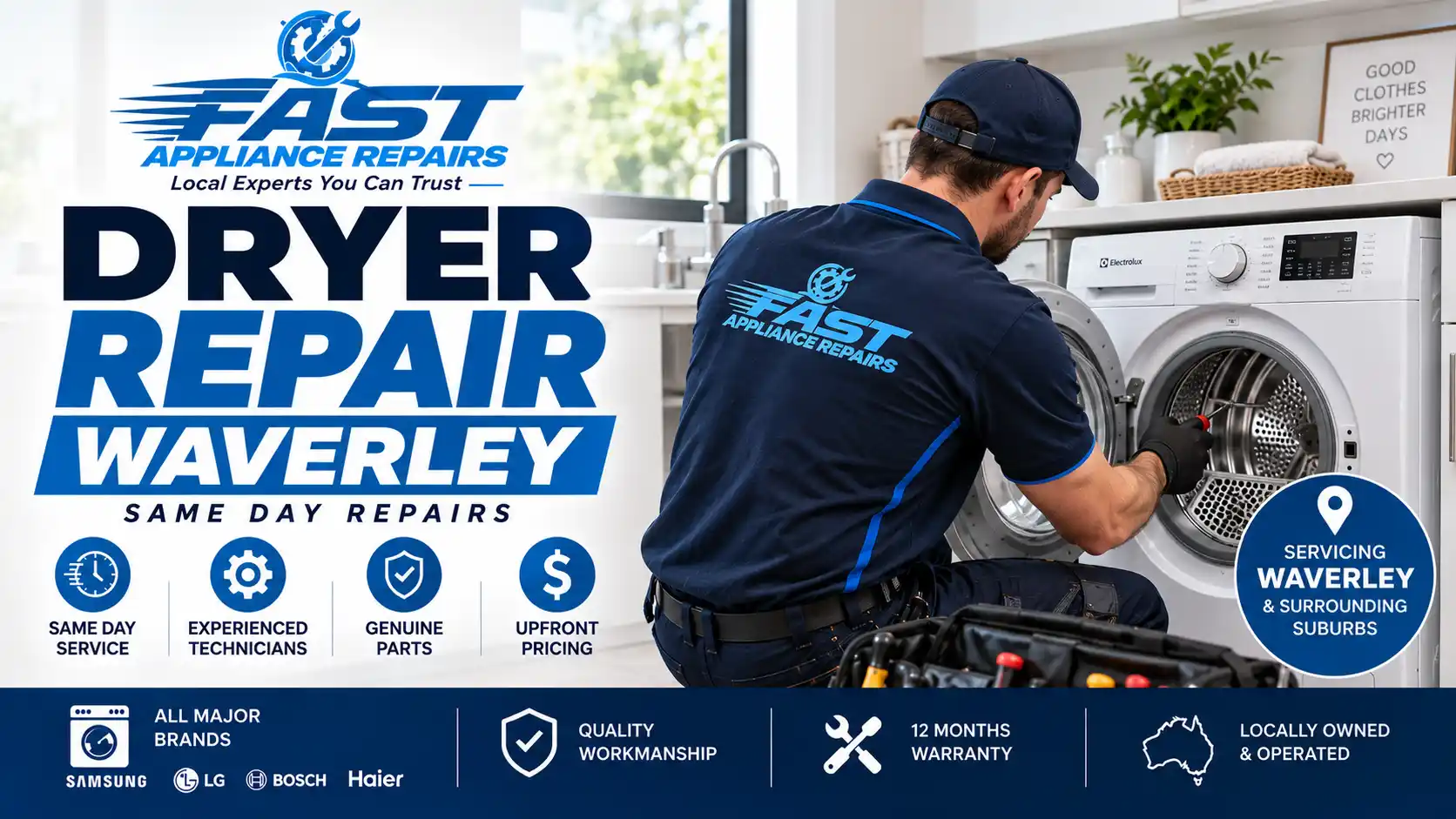
Dryer repair Waverley households can book with confidence begins with testing the machine properly rather than guessing from the symptom. If your dryer has stopped heating, will not start, keeps showing an empty-tank warning, leaks onto the laundry floor, or now takes twice as long as it used to, Fast Appliance Repairs covers Waverley and the surrounding Eastern Suburbs across condenser, vented and heat pump models from every major brand.
Waverley has a lot of condenser dryers, and they fail differently from the vented machines most dryer advice is written about. A condenser dryer that has stopped drying properly is very often not broken at all. It has a blocked condenser, a part most owners do not know exists, let alone that it comes out for cleaning. To book a clothes dryer technician for Waverley, call 1300 144 431 and describe exactly what the machine is doing.
Fast Appliance Repairs provides methodical on-site diagnostics, authentic parts, and clear upfront quotes for condenser, heat pump, and vented drying systems across Waverley.
Diagnosing blocked heat exchanger fins, secondary filters, and restricted airflow passages that cause long drying cycles.
Methodical checks on closed refrigerant circuits, evaporators, sensors, and electronic boards without guesswork.
Addressing cupboard overheating, airflow limitations, stacked washer-dryer configurations, and tight laundry spaces.
We test under power first, explain the exact fault, and quote parts and labour clearly before touching anything. Zero surprise invoices.
Need prompt clothes dryer technician attendance in Waverley or the Eastern Suburbs? Call our service line directly.
Call Dispatch: 1300 144 431Waverley takes in some of the densest housing in the Eastern Suburbs, from the apartment towers around Bondi Junction to the walk-up blocks and converted terraces running down toward Bronte and Bondi. In most of those homes there is no external wall to vent a dryer through, and cutting one through a strata building or a heritage facade is rarely practical.
That leaves two options: a condenser dryer or a heat pump dryer. Heat pump models are more efficient but cost considerably more to buy, so in rentals, investor-owned apartments and budget renovations the condenser dryer is the usual choice. The result is that condenser dryers make up a much larger share of the machines we attend in Waverley than they do in suburbs with more freestanding houses, and understanding how they work explains most of the faults we see.
A condenser dryer heats air with an element, the same as a vented machine, and passes it through the clothes. Instead of blowing that warm, wet air outside, it passes it through a condenser, a heat exchanger that cools the air so the moisture condenses into water. The water drains into a removable tank or, if the machine is plumbed, down a drain hose. The now-dry air is reheated and sent back through the drum.
Everything about that cycle depends on the condenser being clear. Lint that gets past the primary filter settles in the fins of the condenser block. Over months it builds a mat that stops air passing through, so the machine can no longer remove moisture from the air. The result is exactly the complaint people call about: the dryer runs for hours, the clothes come out warm and damp, and the owner assumes the element or the thermostat has failed.
Condenser dryers also put their heat into the room. Unlike a vented machine, which sends hot air outside, a condenser dryer releases the heat it removes from the air into the laundry around it. In a small apartment laundry cupboard with the door shut, the space heats up quickly, and a dryer surrounded by hot air cannot cool its condenser efficiently. Leaving the cupboard or laundry door open while it runs makes a measurable difference.
On most condenser dryers the condenser block is removable. It sits behind a panel at the base of the machine, usually the kick plate at the front, and it slides out for rinsing under running water. Many owners have never opened that panel and do not know it is there. Manufacturers generally recommend cleaning it every month or so, depending on use. A block that has never been cleaned in several years is often almost completely blocked, and rinsing it restores the machine to normal.
Some condenser models are described as self-cleaning, using water to flush the condenser automatically. Those still clog, more slowly, and still benefit from the occasional manual check where the design allows one.
These are the faults we attend most often across Waverley, along with what usually causes them.
On a condenser dryer this is the single most common complaint we attend, and the usual cause is a clogged condenser block or a blocked secondary filter in front of it. Check both before booking. If the block is clean, the primary lint filter and the space the machine sits in are next: a condenser dryer working in a closed, hot cupboard will always run long. If the airflow path is genuinely clear, a partly failed element, a drifting thermostat or a moisture sensor coated in fabric softener residue produces the same symptom.
The water tank warning lights up even though the tank has just been emptied, and the machine will not run or stops mid-cycle. The usual causes are a tank not seated fully in its housing, a float or level sensor stuck by lint or residue, a failed condensate pump that is not moving water up into the tank, or a blocked channel between the sump and the pump. On plumbed machines, a kinked or blocked drain hose produces the same warning. Reseating the tank and checking for a kink are worth doing first. If the light persists, the pump or the sensor needs attention.
A condenser dryer leaking onto the floor is almost always a water handling fault rather than anything to do with heating. A tank left to overflow, a cracked tank, a blocked condenser forcing condensate to spill before it reaches the sump, a failed condensate pump, or a split or disconnected drain hose on a plumbed installation account for nearly all of it. In an apartment, a slow leak can reach the unit below, so it is worth acting on quickly rather than mopping around it.
The drum turns, the cycle runs, and the load comes out cold. Condenser dryers use a conventional heating element, so this generally means a failed element, a blown thermal fuse or a thermostat that has failed open. The thermal fuse rarely blows without cause: restricted airflow, very often a blocked condenser or a machine running in a closed hot cupboard, triggered an overheat first. Replacing the part without clearing the cause guarantees a second callout, so the whole airflow path is checked before anything is fitted.
The machine runs for a while, shuts down, and often restarts once it has cooled. On a condenser dryer that is either overheat protection, usually from a clogged condenser or poor ventilation around the machine, or a full or incorrectly seated water tank halting the cycle. The display usually tells you which, and a thermostat cutting out early produces the same behaviour as an overheat, so both are tested rather than assumed.
Nothing responds when you press start. The most common cause is a worn door switch, which the machine reads as an open door. On a condenser dryer, a full tank warning will also prevent a start on most models. Beyond that, the start switch, the thermal cut-out, the supply side and the control board all come into play. Before booking, confirm the door is latched, the tank is empty and seated, the outlet is live and neither the breaker nor the safety switch has tripped. Call 1300 144 431 if everything checks out.
You can hear the motor running but the drum sits still. That is the signature of a stretched or snapped belt, one of the more affordable repairs we carry out. Where there is no motor sound at all, the motor, the motor capacitor or the start switch is the likelier cause. A seized idler pulley will also stop the drum while the motor keeps running, so the pulley is inspected as part of the job.
Noise is diagnostic if you listen to its character. Intermittent rattling is usually something loose in the blower housing, a coin, a button or a bra underwire. Squealing that changes with drum speed usually means a worn drum roller or a glazed belt. Rhythmic thumping points to a worn drum bearing or a flat spot on a support roller. Grinding suggests a bearing running metal on metal. A buzzing or humming from the base of a condenser machine during the cycle is often the condensate pump, and a pump that has become noticeably louder may be failing.
If the cabinet is too hot to touch, the laundry feels like a sauna, or there is a hot or burning smell, stop using the machine and switch it off at the wall. On a condenser dryer the usual cause is a clogged condenser block, a blocked filter, or a machine running in a small closed space that has heated up around it. A thermostat that has failed closed and no longer cuts the element at temperature is the other possibility. Call 1300 144 431 the same day.
Tripping the circuit breaker or safety switch, a burning smell, sparking, or a visibly damaged cord or plug all mean the same thing: switch off at the wall and stop using the machine. Repeatedly resetting a breaker on an appliance that keeps tripping it is how a small fault becomes a serious one.
Condensate pumps, level sensors, water tanks, belts, switches, and thermostats are routine replacements that cost a small fraction of a new machine and are usually completed on the first visit.
Control boards are the least common and most expensive dryer components. We test all sensors, switches, and wiring thoroughly before ever condemning a control board.
Condenser dryers dominate in Waverley's apartments, but vented and heat pump models are common too, and we service all three.
Vented dryers remain in Waverley's freestanding houses and older properties where an external wall vent exists. They heat air, pass it through the load and expel it outside, so faults concentrate on the element, thermostats, thermal fuse and airflow path. They are the simplest type to repair and the most sensitive to a crushed or overlong duct.
Heat pump dryers are increasingly common in renovated Waverley apartments. They look much like condenser dryers and also collect water in a tank, but they recycle heat through a sealed refrigerant circuit rather than generating it with an element, which makes them far more efficient and gentler on fabrics. They share the condenser dryer's filter and water handling faults, with an evaporator taking the place of the condenser block, and they run longer cycles by design. Where a fault sits inside the sealed refrigerant circuit, that is licensed work, and we will tell you plainly what the machine needs. (Heat Pump Dryer Repair Sydney).
If you are unsure which type you have, check whether there is a water tank. No tank and a vent hose means vented. A tank means condenser or heat pump, and the model number or rating plate will tell you which.
We service all major clothes dryer brands, so there is no need to hunt down a brand specialist.
Bosch, Electrolux, Beko and Haier all make condenser dryers that are common in Waverley apartments and rental fit-outs, each with its own condenser block and filter arrangement. (Bosch Dryer Repair Sydney).
Samsung, including sensor dry models where cleaning the moisture bars resolves a large share of complaints. LG, across condenser and heat pump ranges including their inverter models. Fisher and Paykel, Westinghouse and Simpson, all well represented in established Eastern Suburbs laundries.
Hisense and Whirlpool, common in recent installs. Miele and Asko, European machines that reward careful diagnosis over parts swapping. (Haier Dryer Repair Sydney).
Most dryer repair work concentrates on a predictable list: heating elements, thermostats and thermal cut-outs, thermal fuses, drive belts, idler pulleys, drum rollers and bearings, motors and motor capacitors, door switches, catches and hinges, drum seals and felts, blower fans and housings, moisture sensors, and control and interface boards. On condenser and heat pump models, the list adds condenser blocks and evaporators, condenser fans, water tanks, float and level sensors, condensate pumps and drain hoses.
On condenser machines the water handling parts account for a larger share of repairs than on any other type: condensate pumps, level sensors and tanks are routine replacements. Condenser blocks are far more often cleaned than replaced. Control boards are the least common and most expensive, which is precisely why they are tested rather than assumed.
Every dryer repair Waverley booking follows the same sequence, so you know what to expect before the van arrives.
Cost follows the part and the labour needed to reach it rather than the badge on the door.
A condenser block clean, filter service, sensor bar clean, drain hose clearance, tank reseating or foreign object retrieval sits at the low end, often not far above the attendance itself. On condenser dryers a meaningful share of complaints resolve at this level, which is worth knowing before assuming a slow machine means an expensive repair.
Condensate pumps, level sensors, water tanks, drive belts, door switches, catches, thermostats and thermal fuses fall in the middle band and cover the largest share of the repairs we carry out. Heating elements sit slightly higher again.
At the upper end are motors, control boards, drum bearings and sealed system work on heat pump models. Bearings are costly less because of the part and more because reaching them means dismantling most of the machine. Stacked and wall-mounted installations also add access time.
We diagnose first, quote second, and start work third. You will know the figure before anything begins. (Appliance Repair Pricing).
A dryer with a failed belt, element, thermostat, door switch, condensate pump, level sensor or roller set is almost always worth repairing. Those parts cost a fraction of a replacement machine and the work is usually completed in a single visit.
The calculation shifts on machines needing major components. A dryer requiring a motor or a control board, where the quote approaches half the price of a comparable new unit, is generally better replaced.
If a condenser dryer is being replaced anyway, it is worth weighing a heat pump model. Heat pump dryers cost more upfront but considerably less per load to run, they put far less heat into a small laundry, and they are gentler on fabrics. In a compact Waverley apartment where the dryer runs in a closed cupboard, the reduced heat output is a genuine practical advantage rather than just an efficiency figure.
For landlords and agents, a dryer already on its third significant repair is generally better replaced than repaired again, because repeated callouts and tenant disruption outweigh the saving.
Waverley sits in the heart of the Eastern Suburbs, and our coverage extends right across the surrounding area: Bondi Junction, Bondi, Bondi Beach, North Bondi, Bronte, Tamarama, Queens Park, Charing Cross, Clovelly, Randwick, Woollahra, Centennial Park, Paddington, Rose Bay, Dover Heights and the wider Eastern Suburbs. (Eastern Suburbs Appliance Repair).
Because we handle clothes dryer repair Waverley jobs alongside washing machine and fridge calls across this corridor, a technician is often already working nearby, which shortens the gap between your call and someone at the door. Same-day attendance is often available, subject to technician availability and location on the day, and booking early in the morning gives you the best chance of it. (Dryer Repair Woollahra).
We service all major dryer brands across condenser, heat pump, and vented systems, carrying dedicated diagnostic gear and authentic replacement parts for each manufacturer.
Serie 4, 6, and 8 condenser and heat pump dryers, SensitiveDrying systems, and self-cleaning condenser units serviced with German precision.
UltimateCare condenser dryers, sensor dry vented dryers, and energy-efficient heat pump models serviced with genuine manufacturer parts.
Popular apartment condenser and heat pump dryers, sensor drying systems, and compact laundry units diagnosed accurately on site.
Sensor-controlled condenser dryers and modern heat pump laundry units repaired with genuine factory replacement parts.
OptimalDry heat pump and condenser dryers, digital inverter models, and smart sensor units diagnosed with precision multi-meter instruments.
Dual Inverter heat pump dryers and condenser models with auto-cleaning condensers serviced with authentic factory spares.
AeroSense vented dryers, condensing units, and heat pump clothes dryers repaired with original F&P factory components.
Reliable vented tumble dryers and front load condenser models serviced promptly with original elements, belts, and sensors.
Dependable Australian classic compact vented dryers and wall-mounted tumble dryers common across Eastern Suburbs homes.
Modern heat pump and condenser dryers with digital sensor cycles diagnosed accurately on site with factory tools.
6th Sense heat pump tumble dryers and condenser units diagnosed methodically with precision electronic testing gear.
German-engineered heat pump and condenser dryers with FragranceDos and PerfectDry technology diagnosed with genuine Miele parts.
Scandinavian luxury Butterfly drying systems, commercial-grade components, and heat pump dryers serviced with authentic spares.
Premium iQ700 and iQ800 heat pump condenser dryers, self-cleaning condensers, and luxury integrated drying suites.
Fast Appliance Repairs provides mobile on-site diagnostics, licensed technicians, and prompt same-day service across all major Sydney regions.
Clear, direct answers regarding clothes dryer diagnosis, condenser block cleaning, heat pump models, and repair costs in Waverley.
It depends on the fault and the part required. Condenser block and filter cleaning, drain hose clearance and sensor cleaning sit at the low end, and a good share of condenser dryer complaints resolve there. Condensate pumps, level sensors, belts, door switches and thermostats fall in the middle. Motors, control boards, bearings and sealed system work sit at the top. We diagnose on site and quote before any work begins.
Often, yes, subject to technician availability and location on the day. Calling early in the morning gives the best chance, and we will tell you honestly at booking whether same-day is realistic rather than promising and rescheduling.
Most commonly a clogged condenser block. Lint that gets past the primary filter builds up in the condenser fins until air can no longer pass through, so moisture cannot be removed. On most models the block sits behind the kick plate at the base and slides out for rinsing. A blocked secondary filter or a machine running in a closed hot cupboard produces the same symptom.
On most condenser dryers it is behind a panel at the base of the machine, usually the kick plate at the front. Open the panel, release the clips or handle, slide the block out and rinse it under running water until the fins are clear, then let it dry before refitting. Check your manual for the exact location and recommended interval, which is often around monthly.
Usually the tank is not seated fully, the float or level sensor is stuck with lint or residue, the condensate pump has failed and is not moving water into the tank, or on a plumbed machine the drain hose is kinked or blocked. Reseat the tank and check the hose first. If the warning persists, the pump or sensor needs attention.
On a condenser or heat pump dryer, almost always a water handling fault: a tank left to overflow, a cracked tank, a blocked condenser causing condensate to spill, a failed condensate pump, or a split or disconnected drain hose. Vented dryers do not normally produce water, so a leak points to one of the tank-based types.
A condenser dryer releases the heat it removes from the air into the room around it, unlike a vented dryer that sends it outside. In a small closed laundry or cupboard the space heats up quickly, which also stops the condenser cooling efficiently. Leaving the door open while it runs helps. Heat pump dryers put out far less heat.
Both have a water tank, so the tank alone will not tell you. Check the model number or the rating plate, usually inside the door or on the back. Heat pump models are also usually labelled on the front or in the model name, and they carry noticeably higher energy efficiency ratings.
Most commonly a failed heating element, a blown thermal fuse, or a thermostat that has failed open. On a condenser dryer, a clogged condenser or a machine running in a closed hot space usually triggered the overheat that caused it, so the airflow path is cleared as part of the repair.
If the motor runs but the drum does not turn, the drive belt has usually stretched or snapped. If there is no motor sound at all, the motor, the capacitor or the start switch is the likely cause. A seized idler pulley can also stop the drum while the motor keeps running.
Yes. Tumble dryer is simply the general term, and we service every configuration it covers: condenser, vented and heat pump models, freestanding, stacked and wall-mounted, across all the brands listed above.
Yes. Filter, evaporator, water handling, sensor, drive and control faults on heat pump dryers are routine work. Faults inside the sealed refrigerant circuit are specialist work, and we will tell you clearly what the machine needs and what that involves.
Yes, and a large share of our work as a dryer technician in Waverley is in apartments, often stacked or in laundry cupboards. Please mention at booking if the building has no lift or if building access or parking arrangements are needed, so enough time is allowed.
If the condenser dryer needs a motor or control board and is getting on in years, a heat pump model is worth weighing. It costs more upfront but considerably less per load to run, puts far less heat into a small laundry, and is gentler on fabrics. If the condenser dryer only needs a clean or a routine part, repairing it is usually the better value.
Professional, honest, and prompt residential clothes dryer repair services for Waverley and the surrounding Eastern Suburbs.
45 Monaro Street, Seven Hills, NSW 2147, Australia
Call 1300 144 431 or email [email protected] to book dryer repairs Waverley and the surrounding Eastern Suburbs can count on. Tell us the brand, the model number if it is accessible, whether the dryer has a water tank, and exactly what the machine is doing, and the technician will arrive with the parts most likely to be needed.