A Hisense washing machine that refuses to spin, sits full of water it won't drain, or flashes an error code halfway through a wash is more than an inconvenience — it usually means a full load of soaking clothes going nowhere. The reassuring part is that most faults follow recognisable patterns, and a good number turn out to be simple. Fast Appliance Repairs covers the problems we see most often across Sydney, setting out checks you can safely do before booking.
Parts & labour fully covered
Hisense washing machines combine modern inverter electronics with everyday laundry utility. When faults occur, accurate diagnosis makes the difference between a simple part replacement and an expensive misdiagnosis. Here is why Sydney households trust our team.
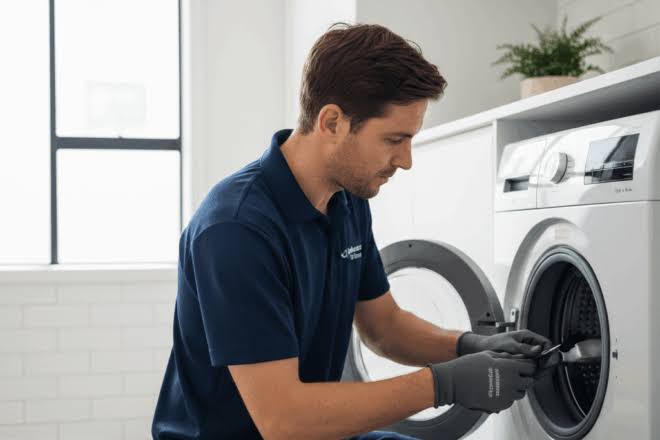
Our technicians are licensed and factory-trained across the entire Hisense laundry range, understanding complex inverter motors and sensors.
We fit genuine Hisense parts, which matters particularly for control boards, motors and sensors where fit and calibration have to be exact.
On site, we run a full diagnostic and read any error code directly from the machine rather than assuming the fault from the symptom alone.
You get a clear quote before any work begins. If you choose not to proceed, you only pay the call-out and diagnostic fee and nothing further.
Most Hisense washing machine repairs are completed on the same visit, and all completed work is backed by our robust parts and workmanship warranty.
If a repair doesn't make financial sense against the age and value of your machine, we will tell you straight rather than sell you the job.
Same-day service is available across Sydney depending on technician availability and location. Calling early gives you the best chance.
The two designs wear differently, which is worth knowing before you book a repair with our team:
Front loaders spin faster and carry the drum on a horizontal axis, so they are more prone to door seal deterioration, drum bearing wear and vibration-related faults. The seal in particular is a consumable — it sits in a wet, detergent-heavy environment and eventually perishes.
Top loaders more commonly develop lid switch faults, agitator or drive-block wear, and suspension rod problems. They are generally gentler on bearings but harder on the components that drive and stabilise the drum. Fill and drain faults show up equally in both.
Some faults resolve in under ten minutes. These checks are all safe to do yourself before calling a technician:
Check the wall switch, plug and circuit breaker. Close the door firmly and listen for the lock engaging — an unlatched door stops most cycles.
Check both water taps are fully open and the inlet hoses aren't kinked behind the machine or clogged with sediment at the filters.
Check the drain hose isn't crushed or pushed too far down the standpipe. Clean the front accessible filter (put a towel/tray down first!).
Redistribute the washing if the machine is banging or refusing to spin. Check the machine sits level and stable on all four feet.
What we ask you not to do: Don't remove the casing or back panel, don't test or replace electrical components, and don't attempt to drain the machine by dismantling the pump housing. Opening the machine yourself can void your Hisense warranty and risks electrical shock.
Here is what tends to go wrong with Hisense washers, and what each symptom is telling you:
If power is confirmed, the two usual causes are the door lock assembly (many models won't power up unless engaged) or the control board and its power supply.
If the wash runs but spin never arrives, look for a worn/slipped drive belt, failing motor, faulty door switch, or a heavily unbalanced load triggering safety sensors.
A still drum with a running motor usually means a snapped drive belt or failed motor coupling. On direct-drive inverter models without a belt, it points to the motor or circuitry.
Standing water almost always traces to a blocked filter (coins, hair clips, lint) or a kinked drain hose. If clear and you hear no pump sound, the drain pump has failed.
A faulty water inlet valve either fails to open (no fill) or fails to close (slow overfill). A failed pressure switch produces the same outcome by misreading drum water levels.
On front loaders, leaks often come from a perished/torn door seal. Also check loose tap fittings, leaking inlet valves, or a cracked drain hose leaving water on the floor.
Grinding/rumbling rising with spin speed indicates worn drum bearings. Banging or walking across the floor points to worn suspension rods, springs, dampers, or unremoved transit bolts.
If the cycle finished but the door stays shut, the lock mechanism has failed or the machine still detects water in the drum. Never force it open, as door hinges damage easily.
Freezing on the same stage or halting without warning usually reports a sensor or control board problem, or a drainage fault waiting for water to clear.
Hisense codes cover drainage, inlet, lock, motor and temp faults. Definitions vary between front/top loaders and production years. We read codes on site against your exact model.
Odour is usually detergent and softener residue building up in the drum, dispenser and seal, accelerated by low-temp washes. A hot maintenance wash and cleaned filter fix most cases.
If washing comes out soapy or soaked, look at drainage and spin. A restricted filter or struggling pump leaves water behind between stages, leaving the load saturated.
If you have checked the power, cleared the filter and straightened the hoses and it still won't run properly, it's a genuine fault that needs a technician.
You should book a Hisense washing machine technician in Sydney immediately if you observe any of the following warning signs:
The cost comes down to the part and how much of the machine has to come apart to reach it. At the lower end sit blocked filters, cleared drain hoses and minor hose-connection leaks, which typically cost little beyond the call-out and diagnostic fee. In the middle sit drive belts, door seals, inlet valves, door locks and pressure switches — affordable parts with moderate labour. At the higher end are drain pump, control board, motor and drum bearing replacements (bearings are labour-intensive as the machine must be substantially stripped).
Is it worth repairing? For most faults, yes — a repair typically costs a fraction of a new machine, and Hisense parts are readily available. The calculation shifts when an older machine needs a major component like a bearing set or control board. We quote on site after diagnosis, and if the repair doesn't make economic sense, we will tell you honestly.
Fast Appliance Repairs provides Hisense appliance repair across Greater Sydney for both residential and commercial customers:
Blacktown, Parramatta, Penrith, Seven Hills, and surrounding Western suburbs.
Castle Hill, Baulkham Hills, Rouse Hill, Kellyville, and Hills corridors.
Liverpool, Campbelltown, Canterbury-Bankstown, and the Sutherland Shire.
Ryde, Strathfield, Newtown, Marrickville, and Inner West communities.
North Sydney, lower North Shore, and surrounding northern suburbs.
Bondi, Randwick, Coogee, and all Eastern Suburbs residential areas.
Search "Hisense washing machine repair near me" anywhere in Sydney and Fast Appliance Repairs is ready to assist.
We make booking and completing your laundry appliance repair straightforward, transparent, and dependable:
You book by phone or email, and we ask for your model number so the technician can arrive with the likely parts already on the van.
On site, our technician runs a full diagnostic and reads any error code directly from the machine rather than assuming the fault.
You get a clear quote before any work begins. If you choose not to proceed, you only pay the call-out and diagnostic fee and nothing further.
Once approved, most Hisense washing machine repairs are completed on the very same visit using genuine quality replacement inventory.
Your machine is fully tested through a spin and drain cycle, and all completed work is covered by a parts and workmanship warranty.
Clear, straightforward answers to the questions we get asked most about Hisense washer repairs:
It depends on the fault. Blocked filters and drain hose clears often cost little beyond the call-out and diagnostic fee. Belts, door seals, inlet valves and door locks sit in the mid-range. Pumps, motors, control boards and drum bearings cost more on both parts and labour. We diagnose and quote before starting any work.
Usually, yes. Most common faults — pumps, belts, seals, valves and locks — cost far less to fix than to replace the machine. Replacement becomes the sensible option mainly when an older machine needs a bearing set or control board.
Most often a worn drive belt, a door switch that isn't confirming the door is shut, a motor fault, or simply an unbalanced load. Redistribute the washing first — if the spin still doesn't start, it needs a technician.
Nearly always a blocked filter or a kinked drain hose. Clear both first. If water still won't shift and the pump makes no sound, the drain pump has likely failed and needs replacing.
With normal household use and regular filter cleaning, a decade or so of service is a reasonable expectation. Not overloading the machine and running an occasional hot maintenance wash both extend that considerably.
Yes. Most leaks trace to a perished door seal, a loose hose connection or a failing inlet valve, and all three are straightforward replacements. Persistent leaks are worth acting on quickly, because water damage to the floor and the machine's electronics costs more than the repair.
Yes — we service both front load and top load Hisense machines, residential and commercial.
Yes. Our technicians are factory-trained and we fit genuine Hisense parts, which matters particularly for control boards, motors and sensors where fit and calibration have to be exact.
Same-day service is often available, depending on technician availability and your location. Calling early in the day gives you the best chance of a same-day booking.
Drainage problems top the list, followed by spin faults, door lock failures and leaking door seals. Between them, those four account for a large share of the Hisense jobs our technicians attend.
If you have checked the power, cleared the filter, straightened the hoses and the machine still won't run properly, our team can diagnose it on site. Contact us today.
45 Monaro Street, Seven Hills, NSW 2147, Australia
Our team can diagnose your washing machine on site, read any error code from the machine itself, and quote you on the spot — with no obligation to proceed. Call 1300 144 431 now for fast, reliable service across Sydney.
